


Why Expertise Matters More Than Ever
A generation ago, the role of a trustee was often understood in relatively straightforward terms: safeguarding assets and administering legal structures. Today, that picture is very different.
Families are increasingly international, wealth is spread across multiple jurisdictions, regulation continues to evolve, and beneficiaries’ expectations have grown. Settlors and beneficiaries are no longer looking only for technical administration; they expect guidance, continuity, and sound judgement throughout the life of a structure.
So, what defines a modern trustee?
While well-considered and thoughtfully drafted legal documents remain essential, the answer lies not in the legal structures themselves, but in the people responsible for managing them.
As Martin Chesler, Chief Executive Officer of Clermont Trust Group, explains:
“The structures themselves have not changed as much as the practical uses and requirements around them. What has changed is the complexity of day-to-day management. Today, what distinguishes a modern trust is not the structure itself, but the capability of the professional trustee.”
That complexity extends far beyond compliance. Trustees today help families navigate changing regulations, evolving family dynamics, and increasingly interconnected financial lives, while maintaining a long-term perspective.
When Does Expertise Become Judgement?
Technical knowledge remains essential, but expertise alone is no longer enough.
Families often rely on lawyers, tax advisers, investment managers and other specialists. Professional trustees require knowledge and expertise in all these fields, however their role is distinctive: to understand how those perspectives come together, ask the right questions and ensure decisions remain aligned with the family’s long-term objectives.
“We are not tax advisers or investment professionals, but we are consumers of that advice. Our role is to curate and understand it comprehensively, implement it appropriately, and help clients navigate the wider picture,” notes Martin.
That wider perspective has become one of the defining characteristics of modern trusteeship. Good governance is rarely about making one significant decision. More often, it is about making hundreds of considered decisions over many years.
Designed for the Long Term
Does a more complex world require more complex structures? It is an easy assumption to make. In reality, complexity is only valuable when it serves a clear purpose.
For internationally connected families, different jurisdictions, legal systems and reporting requirements are often unavoidable. The challenge is not to eliminate complexity altogether, but to ensure every element contributes to the overall objective.
“A good structure should not only work today. It should continue to work as circumstances change and remain practical for the family it serves. The best advice to any client is to keep it simple, ‘road-test’ the structure they are being offered, avoid it being, or over time becoming, complex for the sake of it, and ensure it is future-proof,” says Elliot Goodman, Managing Director at Clermont Trust Group.
How do you know whether a structure has been designed well?
“When we look at a structure, we ask whether it will still work in five, ten or twenty years’ time — not just whether it works today. You can’t predict the future, but you can design structures that take account of potential legislative changes and are better prepared for them,” adds Elliot.
Long-term planning is not about predicting every future event. It is about creating structures that are resilient, proportionate and capable of adapting as families, legislation, and circumstances evolve.
Why Trust Still Matters
Technology continues to reshape professional services, while regulation has transformed the fiduciary landscape over the past three decades. Yet one principle has remained unchanged.
Families choose a trustee because they are placing confidence not only in a legal structure, but also in the people responsible for steering it over time.
“A Trust is not called a Trust for nothing,” points out Martin. “Technical expertise is essential, but it must be matched by emotional intelligence. Today’s trustee needs both the knowledge to guide families through complexity and the ability to build lasting, trusted relationships across generations.”
The idea goes far beyond the legal definition of a trust. It sits at the heart of fiduciary services.
“Clients place enormous confidence in the structures we administer. That means our responsibility goes well beyond getting the technical aspects right. It is about being dependable, exercising sound judgement, and helping families make decisions with confidence over the long term,” reflects Elliot.
Families entrust trustees with responsibilities that often span generations, expecting them to exercise independent judgement, act with integrity, and make decisions that remain aligned with the family’s long-term interests.
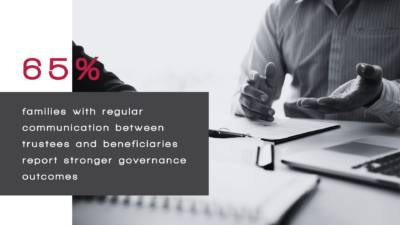
Source: 2025 Family Enterprise Governance Report (UBS and Agreus)
Martin also notes:
“Clients are not simply looking for someone to administer a structure. They are looking for someone they can rely on when circumstances change, when difficult decisions need to be made, and when the next generation begins to take on responsibility.”
Trust cannot be built through legal documents alone. It is earned through consistency, professional judgement, integrity, and relationships developed over time.
That is why modern trusteeship extends beyond administration. It requires understanding not only the structure itself, but also the family’s objectives, responsibilities, and aspirations for future generations.
More Than a Trustee
The fiduciary profession will continue to evolve, but its foundations will remain the same.
“Technology will continue to change the way we work, and legislation will continue to evolve. What won’t change is the importance of good judgement, strong relationships, consistency, and helping families make decisions that stand the test of time,” concludes Elliot.
The modern trustee is no longer defined solely by the stewardship of legal structures, but by the ability to bring all those qualities together. Ultimately, the role is to help families navigate complexity with clarity, continuity and confidence, while preserving what matters most for generations to come.
Read more about the Clermont Trust Group here. Follow us on LinkedIn and YouTube.

