


Lessons in Business and Life from Clermont Co-Founder Jeff Margolis
At 88, Jeff Margolis has accumulated more than a few stories about business. There have been periods of growth, difficult decisions, changing markets, demanding clients, new offices, new generations of colleagues and a few lessons learned the hard way.
But when asked to distil decades of experience into a handful of principles, his answers are remarkably straightforward.
Build relationships. Stay resilient. Give clients genuine value. Plan ahead. Watch the cash flow. Look after yourself. And never stop learning.
These are Jeff Margolis’ seven golden rules.
They are also, in many ways, part of the story of Clermont Trust itself.

Jeff Margolis and Norman Epstein, co-founders of Clermont Trust
From a Small Team to an International Group
The roots of Clermont stretch back to Jeff Margolis’ move from Cape Town to London in 1979, a step that introduced him to a dynamic international financial centre and new possibilities.
In 1985, Jeff established his trust management business. It was a small operation, with Caroline Scanlon and two other colleagues working alongside him.
Norman Epstein’s arrival in 1996 was, in Jeff’s words, “a major, major event” in the history of the organisation. He joined Jeff’s existing firm, bringing with him his own client base, and Clermont began the next stage of its development.
The company continued to expand organically. Serviced offices became too small, the team moved, recruited more people and gradually extended its reach.
That sense of continuity is still present at Clermont, with Caroline remaining part of the group.

Jeff Margolis and Caroline Scanlon – Casablanca, 2026
Today, Clermont Trust is an international organisation of more than 140 colleagues operating across seven jurisdictions.
Yet when Jeff reflects on what made that growth possible, he does not begin with offices, acquisitions or numbers. He begins with people.
Rule 1: Build Relationships with Clients and Your People
“Successful relationships are likely to last quite a long time and can span more than one generation of the same family.”
For Jeff, relationships are at the heart of fiduciary work. Trusts and family structures are created with the future in mind, which means a relationship may begin with one generation and continue with children and grandchildren many years later. This makes knowing the people and families behind them just as important as understanding the structures themselves.
“You need to take care of them. You need to understand who you’re dealing with.”
That connection goes beyond technical requirements. Jeff recalls how shared interests, conversations about family, sport, food or everyday life often helped strengthen professional relationships.
The same philosophy applies internally. Once good people have been selected, Jeff believes employers have a responsibility to train them and create an environment where they feel comfortable, valued and happy to work. The return is not simply employee satisfaction.
“When staff value their jobs, they take care of the company.”
Jeff believes this has been fundamental to Clermont Trust’s success. Over the years, he has watched colleagues support the organisation, protect it and contribute to its development, an ethos he says he rarely encountered elsewhere during his wider professional career.
As Clermont has evolved, maintaining that sense of connection has naturally become more complex. Personal relationships cannot depend on one or two individuals. They have to become part of the culture.
Rule 2: Develop Mental Stamina and Turn Problems into Challenges
Business rarely develops in a straight line.
“There are enormous pressures, and problems of all magnitude arise daily,” Jeff says. “You have to have the mental stamina to tackle these problems.”
His approach is simple: change the way you look at them.
“Treat your problems as challenges.”
It is a subtle distinction, but an important one. A problem can feel like something happening to you. A challenge is something you can work through. That mindset has been tested throughout Clermont’s history.
Jeff recalls one particularly difficult period involving the group’s former Monaco operation, when there were concerns that a growing divide could affect important client relationships. The situation ultimately led Clermont to establish its own presence in Switzerland.
“It was a learning. It was a lesson.”
Looking back, Jeff also credits Martin Chesler, now Clermont Trust’s CEO, who was already part of the team, with handling that period particularly well.
For a smaller company, moments like these can be defining, but the experience ultimately strengthened the business. That is what Jeff means by mental stamina: not avoiding difficult situations, but learning how to move through them.
Rule 3: Make Sure the Client Receives Genuine Value
Few ideas come through more strongly in Jeff’s conversation about clients than value.
“You have to ensure that the clients receive value for what we do and what we charge for.”
In professional services, hours worked and value delivered are not always the same thing. Administrative work may be essential, but Jeff believes clients also need to understand what has been achieved for them. That requires tangible outcomes and clear communication.
For longer or more complex matters, he stresses the importance of keeping clients informed rather than disappearing into the work and reporting only at the end. Regular updates demonstrate progress, create confidence and reinforce the relationship.
But delivering value begins even earlier. It starts with understanding what matters to the client. Clermont’s clients are often sophisticated individuals, families and advisers with complex interests and long-term objectives. Serving them well means shaping the service around those priorities. And the relationship is not one-directional.
Jeff says some of his greatest lessons have come from watching clients themselves.
“One can learn a lot from clients.”
Over decades of advising successful entrepreneurs and families, Jeff has also learned from the way they make decisions and respond to challenges — turning the best relationships into an exchange of knowledge, experience and perspective. And when genuine value and genuine connections come together?
“If you provide value to clients, basically you could have a client for life.”
Rule 4: Plan Ahead and Tackle the Difficult Things First
Jeff’s next rule is refreshingly practical.
“Look at your work schedule and plan ahead.”
He suggests beginning each week by considering what needs to be accomplished and, where possible, confronting the hardest task first.
“Get them behind you.”
It is uncomplicated advice, but it reflects a broader philosophy that has shaped Clermont’s development. Long-term organisations require long-term thinking. Over the years, that has meant knowing when to recruit, when additional office space was needed, when a new jurisdiction made sense and when circumstances demanded a different direction.
Jeff also remembers important moments when new leadership joined the team. Reflecting on the arrival of Martin Chesler and, later, Elliot Goodman, the Group’s Managing Director, Jeff points to the importance of strong leadership at key stages in Clermont’s development. His assessment is simple:
“The right people at the right time.”
Growth, in other words, is not just about moving faster. It is about preparing for what comes next.
Rule 5: Never Underestimate Cash Flow
Jeff’s fifth rule may be less philosophical, but he considers it fundamental.
“One of the most important things in business, if not the most important thing, is cash flow.”
Even the strongest strategy depends on having the financial capacity to support it.
“Your ambitious plans and all your schemes can be fantastic on paper, but if it doesn’t provide the cash flow for you to run your business, life will be very, very tough.”
Jeff remembers cash flow being particularly challenging during the early years. Clermont has evolved significantly since then, but the principle remains the same. For Jeff, long-term success still comes back to strong fundamentals and financial discipline.
“Two and two still equals four,” Jeff remarks, with a touch of dry humour.
Complexity may increase. Markets may shift. Regulation and technology may change. The core principles remain remarkably consistent.
Rule 6: Look After Your Health and Enjoy the Journey
Longevity in your career means very little if it comes at the expense of everything else.
“You need to be able to perform at your maximum abilities and to enjoy life and to enjoy your business environment.”
Jeff recognises that some aspects of health are beyond our control, but there is still much we can influence. Exercise, proper sleep, eating well and looking after our health all play a part. It is a principle that can easily be overlooked in the pursuit of hard work and achievement, yet it is one of the most important.
After decades in business, Jeff sees personal wellbeing and professional performance as closely connected. Looking after one helps sustain the other.
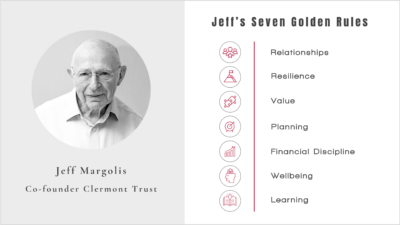
Jeff’s Principles for Business and Life
Rule 7: Keep Learning Because the World Keeps Changing
Jeff saves his most forward-looking principle for last.
“Always keep on learning, because you can’t walk around with a closed mind.”
Experience is valuable. But experience should never become certainty that there is nothing left to discover.
“You don’t know everything, and you will learn something virtually every day.”
For someone who has watched the fiduciary industry transform over several decades — through regulatory change, globalisation, technology and increasingly complex client needs — that message carries particular weight.
It is equally relevant to Clermont today. The group has evolved from a small UK-based firm into an international organisation. Its scale, capabilities and geographical reach are very different from those of its early years. But evolution cannot stop because a particular milestone has been reached.

Clermont Trust Team, Casablanca 2026
As Jeff puts it: “Don’t settle for who you are now, because the world is changing. And if you want to stay ahead, you should keep learning.”
Principles That Outlast Generations
What is striking about Jeff’s seven rules is how little they depend on a particular decade, technology or way of working.
They helped shape Clermont from a small team into an international group, while preserving its independence and owner-managed structure. Those same principles continue to resonate in the way the group operates today: through long-term relationships, committed people, independent thinking and responsible stewardship.
Thirty years after Clermont was formally founded — and more than four decades after Jeff first began his international trust management career — the organisation is very different in scale. The principles behind it are remarkably familiar.
That may be the real lesson. Building something that lasts is rarely about finding a single secret to success. It is about getting the fundamentals right, holding on to them as the company grows, and continuing to learn along the way.
Read more about the Clermont Trust here. Follow us on LinkedIn and YouTube.
***
About Jeff Margolis:
Jeff is Co-Founder of Clermont Trust and, earlier this year, celebrated 70 years in the profession. He established his international trust management business in 1985, with Norman Epstein later joining with his own client base. Clermont Trust was formally established in 1996.
Jeff qualified as a Chartered Accountant in Cape Town in 1963 and practised there until 1979, becoming a partner at Epstein, Bloch & Co, now Grant Thornton. After moving to the UK in 1979, he continued to practise as a Chartered Accountant before becoming a shareholder in a licensed deposit-taking business.
He also co-founded Spring Finance Limited, a UK-based FCA-regulated mortgage lender, and the Cheval Bridging Finance Group, which became a leading participant in the regulated bridging finance market.

